A Message to all Creationists.
I've recently received a lengthy comment to a post I wrote called "A Message to all Christians". The original comment from a creationist is here. My response is applicable to all creationists, and so I address it to you all, but I am going to respond specifically to this anonymous comment. I'd suggest reading the original comment first. You will likely, as a creationist, find yourself absolutely convinced by the arguments raised. Then prove yourself honest and read the other side of argument below. Anyway, here is my response:
Dear Anonymous,
I am going to perform for you the most gratuitously amicable favour of introducing you to reality. There will be no need to thank me afterwards. I do this purely to assist you in avoiding the same mistakes twice. This is going to be a long response and there will be no pictures. I will try to be as concise as possible but I trust you will understand that at times brevity must be sacrificed for the sake of accuracy and allowing space to provide the facts.
Your anecdote regarding a palaeontologist not believing in evolution was a delight to read, if only for the sheer improbability of the occurrence. You see the percentage of scientists qualified in the earth and life sciences (the relevant scientific fields) in your country that do not support the theory of evolution is 0.15% (Robinson 1995, data from Gallup). Since this is the same percentage of qualified historians that are Holocaust deniers, I must congratulate you on your improbable find. Perchance congratulations are not in order though, if it is this one improbable encounter that has led you to a life of subsequent delusion and probably the greatest cause for ignorance in your life.
Let's go through the quotes you provide to support your argument.
First you misquote Darwin as follows:
"Often a cold shudder has run through me, and I have asked myself whether I may not have devoted myself to a phantasy." (Charles Darwin, Life and Letters, 1887, Vol. 2 p.229)
Instead of answering you myself let's leave it up to Darwin by putting this particular quote back into it's context within the letter from which it was extracted, which was from a letter from Charles Darwin to Charles Lyell. I have highlighted your quote in italics and used bold to highlight the context within which it appears.
Ilkley Wells, Yorkshire,
November 23 [1859].
My dear Lyell,
You seemed to have worked admirably on the species question; there could not have been a better plan than reading up on the opposite side. I rejoice profoundly that you intend admitting the doctrine of modification in your new edition; nothing, I am convinced, could be more important for its success. I honour you most sincerely. To have maintained in the position of a master, one side of a question for thirty years, and then deliberately give it up, is a fact to which I much doubt whether the records of science offer a parallel. For myself, also, I rejoice profoundly; for, thinking of so many cases of men pursuing an illusion for years and often a cold shudder has run through me, and I have asked myself whether I may not have devoted my life to a phantasy. Now I look at it as morally impossible that investigators of truth, like you and Hooker, can be wholly wrong, and therefore I rest in peace. Thank you for criticisms, which, if there be a second edition, I will attend to. I have been thinking that if I am much execrated as an atheist, etc., whether the admission of the doctrine of natural selection could injure your works; but I hope and think not, for as far as I can remember, the virulence of bigotry is expended on the first offender, and those who adopt his views are only pitied as deluded, by the wise and cheerful bigots.
I cannot help thinking that you overrate the importance of the multiple origin of dogs. The only difference is, that in the case of single origins, all difference of the races has originated since man domesticated the species. In the case of multiple origins part of the difference was produced under natural conditions. I should infinitely prefer the theory of single origin in all cases, if facts would permit its reception. But there seems to me some à priori improbability (seeing how fond savages are of taming animals), that throughout all times, and throughout all the world, that man should have domesticated one single species alone, of the widely distributed genus Canis. Besides this, the close resemblance of at least three kinds of American domestic dogs to wild species still inhabiting the countries where they are now domesticated, seem to almost compel admission that more than one wild Canis has been domesticated by man. [Page 26] I thank you cordially for all the generous zeal and interest you have shown about my book, and I remain, my dear Lyell,
Your affectionate friend and disciple,
CHARLES DARWIN.
Sir J. Herschel, to whom I sent a copy, is going to read my book. He says he leans to the side opposed to me. If you should meet him after he has read me, pray find out what he thinks, for, of course, he will not write; and I should excessively like to hear whether I produce any effect on such a mind.
So, as you see, and you can clearly confirm this yourself, Darwin was certainly not claiming his discovery to be a fantasy.
Your next quote:
"Evolution is the backbone of biology and biology is thus in a peculiar position of being a science founded on unproven theory. Is it then a science of faith? Belief in the theory of evolution is thus exactly parallel to belief in special creation. Both are concepts which the believers know to be true, but neither up to the present, has been capable of proof." (L.H. Matthews, Introduction of the 1971 edition of Origin of the Species pp. x,xi)
I do not posses a copy of the 1971 edition of Origin of Species and neither can I verify its existence. You will however note that Darwin died in 1882 and thus, even if your quote is genuine, I find little connection between Darwin's work and a 1971 quote.
In fact, the only place I can find that quote is on creationist web sites and in a 64 page booklet by the creationist Ralph O. Muncaster. I do not know that the quote is a fake as I do not have the reference to demonstrate that, however it is extremely likely that it is a fake and that it has never appeared in any publication of The Origin of Species. Even if I am wrong and this quote does appear in an edition of the Origin of Species, it is simply the comment of a secondary commentator which is thoroughly rebuked by the simple fact that significant evidence does exist for evolution. The latest such evidence published is the observation of a rapid evolutionary change in the Great Eggfly (a.k.a. Blue Moon) butterfly on the Samoan Island of Savaii published in the July 13 edition of Science.
Furthermore, scientific theories are never proven. That is simply not how science works and any scientist would know that. They may only be disproved. A theory is a hypothesis that has been tested and supported by subsequent evidence. So the theory of evolution is a tested hypothesis that is to date supported by absolutely all resultant evidence and contradicted by none. If this were not so the theory of evolution would be a disproved theory and relegated to the junk heap of human imagination.
In other words, this quote reveals only that you, and the person you quote, are not in accordance with the evidence and demonstrate no knowledge of the scientific method.
Moving on you then choose to quote Darwin again, claiming not to have written down the precise source of the quote:
"To suppose that the eye, with all its inimitable contrivances for adjusting to the focus of different distances, for admitting different amounts of light, and for the correction of spherical and chromatic aberration could have been formed by natural selection, seems, I freely confess, absurd in the highest degree." (Charles Darwin, Origin of the Species
I did not write down the page number. I'm sure you can look it up in your own copy. I believe it is from the chapter entitled, "Problems with the Theory.")
Let's put this one in context as well by providing the full quote, which incidentally can be found in The Origin of Species, Chapter 6, under the heading "Organs of extreme perfection and complication". Again I have highlighted your partial quote in italics. It does not seem necessary to bold the relevant context since it is all entirely relevant.
To suppose that the eye, with all its inimitable contrivances for adjusting the focus to different distances, for admitting different amounts of light, and for the correction of spherical and chromatic aberration, could have been formed by natural selection, seems, I freely confess, absurd in the highest possible degree. Yet reason tells me, that if numerous gradations from a perfect and complex eye to one very imperfect and simple, each grade being useful to its possessor, can be shown to exist; if further, the eye does vary ever so slightly, and the variations be inherited, which is certainly the case; and if any variation or modification in the organ be ever useful to an animal under changing conditions of life, then the difficulty of believing that a perfect and complex eye could be formed by natural selection, though insuperable by our imagination, can hardly be considered real.
It doesn't quite present the opinion you were attempting to claim it does, does it! In fact, it states the reverse.
I believe at this point we are starting to see a pattern emerge. The quotes you offer are classic examples of the intellectually vacuous practice of quote mining – the practice of taking small quotations from within their explanatory context to attempt to reverse their meaning, a classic and dishonest tactic of creationist goons, incapable of facing reason and so determining to cheat and lie instead. When they are not cases of quote mining then they are nothing more than commentary by others and represent nothing more than an argument from authority, a classic logical fallacy known to be worthless by atheist and theist philosophers alike, without even the good grace to provide a credible source for that "authority". Anyway, let's move on and see if matters improve.
Your next quote:
"Evolution is unproved and improvable, we believe it only because the alternative is special creation, and that is unthinkable." (–Sir Arthur Keith, a Scottish anatomist and anthropologist, and was a leading figure in the study of Human fossils.)
I can't find this quote attached to Sir Arthur Keith in any source other than creationist literature. Since it is well published that he was in fact a proponent of evolution, I suspect this also to be a fake. Regardless, it would still be nothing more than an argument from authority and thus worthless. Evidence is required, not opinion, regardless of who's the opinion is.
I'd also point out that the fifth word of the quote is "improvable" and not "unprovable", which I suspect many people misread or misinterpret. I'll mention one last time that science never proves theories; it only offers evidence to support them or evidence that disproves them. Only evidence to support evolution has ever been found. You seem unaware of the scientific method and perhaps that is why you do not appreciate it.
However, even if the above quote is not a fake allow me to point out that Keith was suspected as a co-conspirator of the Piltdown Man Hoax and was not an anti-Christian as the creationist literature claims but he did have some unusual ideas regarding Jews. Amongst his famous quotes that are verifiable are such gems as:
"Another mark of race possessed by the Jews must be mentioned. Their conduct is regulated by a ‘dual code‘; their conduct towards their fellows is based on one code (amity), and that towards all who are outside their circle on another (enmity). The use of the dual code, as we have seen, is a mark of an evolving race. My deliberate opinion is that racial characters are more strongly developed in the Jews than in any other race."
Sir Arthur Keith, ‘A new Theory of Human Evolution‘ 1948
And:
"The German Führer, as I have consistently maintained, is an evolutionist; he has consciously sought to make the practice of Germany conform to the theory of evolution."
Sir Arthur Keith, 'Evolution and Ethics', Putnam, New York, 1947, p. 230.
Anyway, that was the last quote you provided, all of which I think I have adequately exposed as the fatuous attempts to gain legitimacy by fraud that they are. Let's move on to the rest of your misunderstanding.
You claim that any honest person must admit that neither evolution nor creationism is actual science. Actually there are many thousands of papers published in peer reviewed scientific journals demonstrating evolution as a science. Many thousands of scientists, including in Iran of all places, carry out research on government and private funds exposing the finer detail on specifics of evolution on a daily basis. Modern pharmacology is highly influenced by evolutionary theory, especially with regards to treatments for bacterial and viral disorders and genetic disease.
Millions of independent pieces of evidence in fields from palaeontology to the study of the HIV virus are all mutually corroboratory and absolute in support of evolutionary theory. In fact, not one single piece of evidence so far discovered and not one living organism yet studied has presented any contradiction to evolutionary theory. The study of evolution is most certainly a science and billions of dollars each year invested globally in all fields of the life sciences absolutely concur with that fact.
Let's move on to creationism, where the conclusion is less kind. Not one shred of evidence that contradicts evolution has ever been presented by creationists. Not one Intelligent Design proponent or Creationist (they are one and the same intellectual abomination) has ever been published in a peer reviewed journal. Creationism as it relates to a young Earth is also absolutely contradicted by evidence from archaeology, anthropology, astronomy, astrophysics, biology, history, genetics, geology, molecular biology, radiology and many other and more specific fields of research. In the meantime not one creationist argument has stood up to scrutiny. Not one creationist has provided any evidence. Not one creationist hypothesis has been proposed and tested and that is why to this date there does not exist a single creationist theory. Creationism is supported by a sum total of ZERO evidence.
Creationism is most certainly not a science.
Your quotes are either misquotes out of their context, which I have provided above, or arguments from authority (meaningless, that is if they are not simply fake). In other words your entire counter argument against evolution amounts to absolutely nothing. Much of your argument after the quotes relies on your Darwin misquotes, which I have already debunked, and so you are left with absolutely nothing in your argument beyond "I have faith", which is all you can have since you have absolutely nothing else to support your belief.
You have misquoted scientists and misrepresented facts and the sole reason that I do not label you as an idiot and a liar is because I am labouring under the generous assumption that you are simply genuinely mistaken and misled by unscrupulous charlatans as opposed to being one yourself. I must point out however that I have trouble maintaining this charitable assumption since in your original anecdote you describe scientists unpacking T-Rex fossils from Utah for assembly whilst on open display, when this would almost certainly be a closed door procedure requiring an exacting inventory and cataloguing procedure which would not take place on the museum floor and the later arrangement would be subject to rigorous and careful safety controls to protect the fossils and this would be so in virtually any museum on the planet, very probably every museum - even in the third world. In other words, I am virtually certain that even the introductory premise for your later comments is an outright lie. As I have previously said though, I shall generously allow you the benefit of this near imperceptible doubt.
Anyway, moving on to the rest of your comment.
You said:
Have you ever visited Mount Rushmore? I have been blessed (or lucky from your perspective :) to have had the opportunity of visiting 47 states, most provinces in Canada and several foreign countries (I am currently composing this message in Africa on my laptop computer and will send it thought an MTN antenna). You would call me a fool if I looked at Mount Rushmore and tried to convince you that water erosion had carved those faces over billions of years. And yet, you choose to look in the mirror every morning and convince yourself that the living, breathing, wonderfully designed image you see in the mirror is a fabulous miracle of natural selection having happened without design over billions of years. [Pause] OK, you have the right to believe that, but please change the name of your blog to something like "choosefaith." -Because truly your faith is far greater than Rhology's or mine.
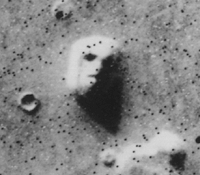
I have travelled extensively, having lived for many years outside of the country of my birth, yet I see no reason why this experience would qualify me or anybody else to comment on matters of scientific truth unless I had undertaken relevant scientific research during those travels and was thus commenting on the evidence. I have not seen Mount Rushmore first hand, but again I find this of no relevance in evaluating the evidence with regards to the theory of evolution. I wonder, have you ever seen of the Face on Mars because it was precisely weather erosion that created that. But that is also absolutely meaningless with regards to evolution.
What your statement really boils down to is this "How can complexity come from a non-intelligent process?" and it is precisely this question that evolution so thoroughly and demonstrably answers. Let's take a more famous example of this same question, William Paley's Watchmaker Analogy:
1. If you look at a watch, you can easily tell that it was designed and built by an intelligent watchmaker.
2. Similarly, if you look at some natural phenomenon X (a particular organ or organism, the structure of the solar system, life, the entire universe) you can easily tell that it was designed and built by an intelligent creator/designer.
Before we go on to complexity in life let's first point out that the formation of the solar system is staggeringly well understood and requires only natural law, not a designer, to have formed the star and the planets and moons and coordinate their motion.
With regards to the complexity of life, Charles Darwin actually read Paley's argument whilst he was studying theology at Christ's College, Cambridge in 1831 and believed it to be rational proof of the existence of a god. Do you understand the importance of that? The watchmaker argument (identical to your Mount Rushmore argument) actually preceded Darwin's discovery of evolution and Darwin himself was convinced by that very same argument prior to his discovery of evolution by natural selection. Darwin, like Paley, believed that living beings showed such a high degree of complexity and that they were so exquisitely suited to their environments that they must have been designed.
Later however, on the voyage of the Beagle, Darwin became suspicious of Paley's argument as he encountered a wider range of species and began to formulate his own ideas. After he had returned from his voyage he formulated his Theory of Evolution by Natural Selection as a superior explanation to Paley's Intelligent Design argument and provided documented evidence to support his new claim.
I think you need to understand that Intelligent Design is not a challenger to Evolution by Natural Selection. Intelligent Design was the established understanding prior to Darwin's theory and was thoroughly defeated by it. The problem here is that you just don't have any education with regards to evolution by natural selection, which is a massive liability for you if you hope to oppose it.
Let me try and fill you in a bit.
Evolution by Natural Selection was so named because Darwin was highlighting the similarity between selection that takes place in nature and the artificial selection that was already well documented and had been used for many centuries by humans in the breeding of a wide range of animals and plants. Artificial selection was well understood and well practiced in the breeding of dogs, cattle, horses, flowers, and a wide array of other plants and animals. It was established fact that by controlling which individuals mated and produced offspring that you could steer towards desirable traits, such as fast horses or spotted dogs, over several generations.
Darwin realised that the same process was possible without a person controlling the breeding. Nature could, and in fact does, control the breeding because the environment determines which animals survive long enough to breed. As the environment changes or as organisms migrate to different environments, nature is selecting which organisms survive long enough to breed and which do not. The result is accumulated changes which over many generations can result in such huge changes that it is no longer possible for organisms to breed with the organisms they originally descended from. That is known as speciation. The whole thing is really that simple.
To sum up evolution by natural selection we can use the following phrase, which I will explain afterwards.
Evolution occurs by the non-random selection of randomly varying replicators.
Now, the replicators are molecules of DNA, the genetic recipe to build an organism. If organisms reproduce sexually, that is by combining their DNA with the DNA of another of their species, then we immediately have variation between the parent and the child because we have a mix of both parents DNA. If the organism reproduces asexually, that is we have only one parent, then the child should be an exact copy of the parent.
Now, what happens with sexual reproduction is that the child has half its genes from one parent and half from the other. These are direct copies of the parent's genes. The combination is new but the genes are not. This is how artificial selection mostly works. We simply combine two parents with the desired trait and thus increase the probability that the offspring will inherit that trait. This is not how we end up with speciation, which is why it is possible to breed a Chihuahua with a Great Dane. Regardless of the variation in genes, two members of the same species have the same numbers of genes in the same addresses (locations within the DNA) and so they can still interbreed.
Rarely however there are errors when the DNA is copied. These errors are changes in the genetic recipe to build the organism and they are often harmless and often harmful but sometimes this random change actually results in a slightly changed offspring that has some small advantage over it's fellows in surviving to breed or having more offspring. This is the same for sexual and asexual reproduction.
Some of its offspring will inherit this new genetic advantage. They will also benefit from being more likely to have offspring and so over time this new or changed section of the genetic recipe becomes more and more common in amongst all the organisms of that type. There are two points to understand here. First, while the change is random whether or not the change helps the organism to survive to breed is not. If the change makes a bird's beak better able to get at a specific plant's seeds then it is obviously not a random truth that the bird that can get at the food stands a better chance of surviving to breed. Secondly, over time, the frequency of that gene – the number of organisms of that type that exist in that environment and carry that gene – will increase.
Now, let's imagine that we have one type of species and its many members live across a wide area. Through changes in the environment some get cut off from the rest and so they become two separate populations. Now, mutations that occur in each population will not be shared across the species as a whole. They may also face different environments and so different non-random selective pressures. Over many generations there is a good chance that each population will accumulate changes that are beneficial for them in their respective locations. If the two populations get back together somehow after a great deal of time then it is even possible that they will have changed so much in comparison to each other that they will no longer be able to interbreed. They have speciated.
This is evolution by natural selection, but it does not require populations to become geographically detached although that is a common factor.
The truth is that the accumulation of tiny changes over many thousands, and even millions, of generations can result in species that are incredibly different. If we follow this logic backwards over the periods of time many different sciences and dating techniques prove that life has existed for, then we can be very secure, also thanks to genetic information that we are now able to read, that absolutely every single living thing on this planet shares a common ancestor. Creationists like to get upset because they think evolutionists are calling them monkeys and this is simply untrue. What we are saying, and what we have mountains of evidence to prove, is that we are related to monkeys and around five million years ago we share a common ancestor with today's chimpanzees. But before you get upset, which incidentally does nothing to change the truth of the matter, keep the following in mind.
Not only are you related to chimpanzees and monkeys but you are related to every living thing that lives now and has ever lived on this world. Absolutely everything from a blade of grass to a whale is not just figuratively but is in actual fact your family. The simple yet beautiful process of evolution by natural selection - an observed, recorded and demonstrated fact supported by every piece of evidence on the planet – connects you to everyone and everything in nature for the entire history of this world. We are all cousins.
Thanks to the evidence, this is undeniable.
Now, you can still keep your faith if you really think you must but you have to face the fact that this creationist stuff is just plain wrong. I personally believe that the evidence shows that your faith is clearly wrong also, but if you can't bite that bullet yet at least face up to the truth that evolution is called a theory in science but in science what we call a theory is what non-scientists call fact. If you'd like read from and get in touch with other Christians that remain Christian but have accepted that evolution is a fact then try the Old Earth Network to begin with. They are Christians who keep their faith but accept the truth of evolution.
If you'd like to know more about the fact of evolution and why creationism is certainly false please feel free to leave me a comment or head over to Talk Origins, where they have article after article and scientific proof after scientific proof that explains the errors and the lies of EVERY creationist argument that has ever been raised.
All the best,
CD
If you enjoyed this article please feel free to digg it down below.